The Static Pulse
The chances of securing such a luxurious abode in the mountainous reaches of North Wales for such a low price are almost unheard of.
A mighty farmhouse, built of locally quarried slate, weathered by the icy breeze that batters it from the Irish Sea to the east.
Despite its typical characteristic properties, there is an uncanniness to it. Such a handsome estate, and a vast building filled with many nooks and rooms for all affairs; albeit neglected, bereft of life, as if it had seen no guests in recent memory.
Nevertheless, my wife, Susie, has deemed it fit for my recovery.
Oh, and my recovery!
I insist that there is something that ails me. She insists that it is the world that ails me—that my symptom is external—but I am convinced otherwise. After all, would I not be in this predicament if I was truly sound of mind?
Susie says this is what I need. Fresh air, and a fresh mind. I would rather have someone to talk to, about my feelings, and such. Susie is a doctor—a physician, in fact—and scoffs at the slightest hint of therapy. "How can words fix a bodily complaint?" she often says.
Of course, she's looked me over, both at my request initially, and at my rebuff soon after.
I'm tired.
Tired of her examinations, and tired of her doubt. She simply does not see what ails me! What is one to do, when someone of her high standing says otherwise?
On an average day, I am administered tonics and tablets of various forms. Perhaps they help, or perhaps they make me forget. The issue remains, buried, festering.
When Susie announced her finding this farmhouse for short-term letting at an absolute steal of a price, I could do nothing but agree.
One positive thing: she has agreed to let me take a break from the medicines and anti-depressants. It's her little test, you see. To detect whether a change of environment is sufficient to heal me.
I disagree with her theory. That being said, London is stifling. The job market is savage. I am being ground down into the dirt, ever since my company made my team redundant, and hired people in the Philippines to do my job. I must have sent thousands of job applications over the past 9 months, to little or no avail. 10 interviews, 3 second interviews, 1 final interview. 8 ghosted me, 1 rejected me, and 1 closed the role for "restructuring."
That is why I welcome the congenial change of scenery; it will surely do me good. As to how good it'll do me for the long-term, I hold little hope.
And that'll be the end of my discussing my condition. Susie says it does me little good to concern myself with it for long periods, and scolds me at any suggestion that my depressive tendencies are rooted in a deeper, internal anxiety.
So I will instead talk about the farmhouse.
The building rests in the center of four hills, rising to the north east, north west, south east, and south west. The house has weighed itself down into the earth, and has sunk out of view from the neighbouring world.
There is no garden. The nature that surrounds the house is in effect one giant, all encompassing garden. If one were to hike a good ten minutes to the north, along the western ridge of one of the four surrounding hills, the town of Barmouth reveals itself, with the sea stretching from south to north. All within the grasp of the eye, and well outside of the grasp of one's voice. Here, we are truly alone. A small black dot on the tip of the hill.
I asked my wife why such a desirable farmhouse was available for such a low price. Typically, a property of this size would be hired by several families travelling together, so that they might share the burden of what should be a severe cost. Susie told me, 'It's newly listed, Thomas. We're the first to stay here since the previous owners passed on.'
'Did they pass in the house?' I asked.
'Don't speak such utter trite,' she remarked. 'Nothing of the sort.' She alluded to something about complications with the heirs of the estate, and a bitter feud between distant cousins. The fact is, the house has remained uninhabited for many years, and seemingly, the renovations made prior to listing the property were sparse (if not non-existent).
Such talk of heirs and co-heirs is terribly objective and boring, and it almost spoils the haunted feeling I have within these cold slate walls. Almost spoils, indeed—the feeling lingers, regardless of how matter-of-fact I speak or think of this house—for there is something wrong with this place.
I made the mistake of revealing my curiosities to Susie (or unfettered conspiracies, as she referred to them) in regards to the ghostliness of the house. Allegedly, this is "precisely what is wrong" with me. I have a tendency for the dramatics, married with an interest in esoterics and gnosticism in my early adult life; all of which Susie says are an "explosive cocktail for neuroticism and every-day hallucinations."
One evening, while sitting in the living room reading our individual books, I'm sure I could feel some disharmonic energy in the air. So much so, that my hair all stood on end.
I even discharged a visible streak of blue electricity from my fingertip to the metal door handle when I went to the bathroom.
What did Susie make of this, you may wonder?
Humidity!
Don't get me wrong, Susie is my darling. We've built our lives together, and watched each other flourish. Up until I ceased to flourish, and rather wilted in the absence of work and in the face of dwindling motivation.
I must remember not to make everything about me, and my woes. My dear wife has her own mind, her own feelings, and I am all too quick to forget these in place of my own. But such is the weight of my burdens. Regardless, I must take care to control myself, as exhausting as it may be. I must at least present the idea of a semblance of recovery during our retreat.
After two weeks, I became completely bored. There is nothing to do here. I have read every book, and every magazine. There is no internet, and Susie forbade me from seeking out a means to acquire it. She says I don't need a job, that we have plenty of savings, and that her salary is more than enough for us to remain comfortable to the end of our days.
It's not the money I need, however. My job defined me, sculpted me from a rough hewn stone into a chiselled gem. Now I fear the incessant ebb of the rolling tide of time will remove that definition that I worked so hard to build.
Alas, there's no use in pursuing my eternal job hunt within these secluded walls.
So, I watch TV.
That black rectangle, the only hint of an advanced technological society within the whole estate, I would wager. Even the lightbulbs are those old incandescent types.
Sometimes, I stare at the black screen. I see nothing, and consequently, I feel nothing. And that's great.
But it's not enough.
In the mornings, Susie takes an hour-long hike around the estate. Up the hills, down the hills, and then some more.
At first, I would join her. But lately, I am far too tired.
Instead, I take a jaunt with her in the late evening, when it is cooler, but not cold. Truth be told, I find myself gasping for air in the icy chill of the first light of morning. The oxygen in the air is few and far between, and the temperature of it stings my throat.
So, I watch TV.
The more I watch, the more I see. That's generally how it's supposed to work, is it not?
Except, the more I watch, the less that is new.
So, I flick through the channels.
The television is new. UHD, 4K. 144hz, whatever that means. The fidelity is unrivalled. Despite the cutting edge hardware, the service contained within that noisy rectangle is quite the opposite. There are no smart features, nor any discs to play. There is only the linear schedule. BBC One on number 1. ITV on number 3. Channel 4 on number 4. You get the picture (pardon the pun).
It leaves a lot to be desired. It leaves a lot to be imagined.
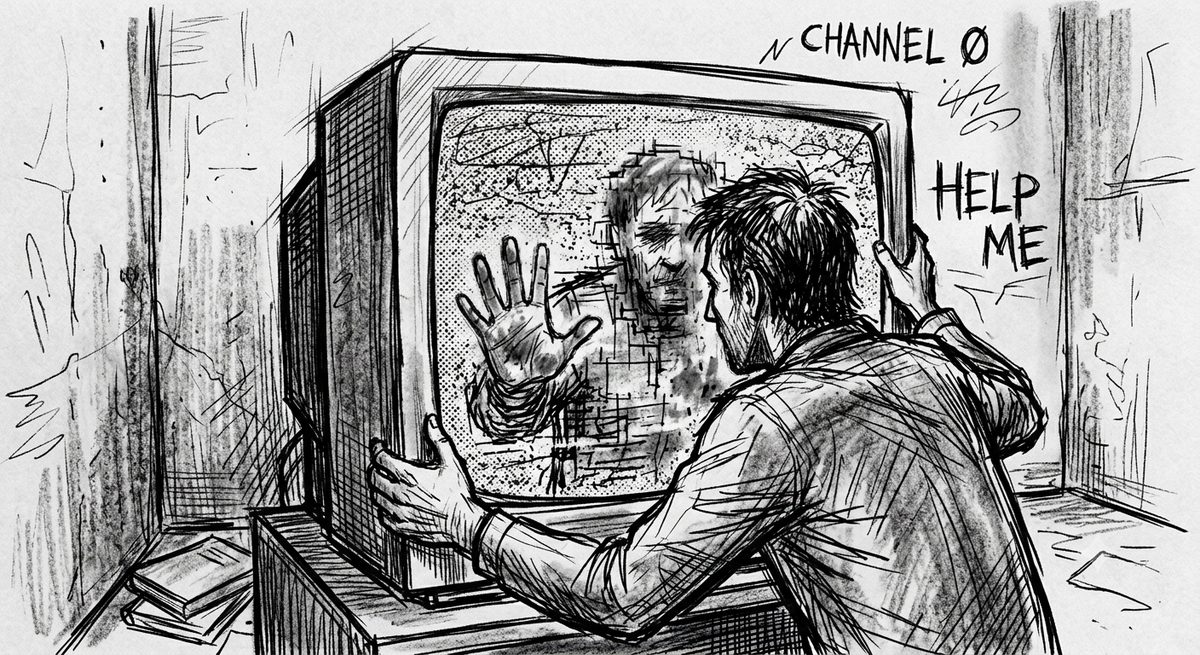
There is one channel that is insightful, though. It's not a channel, per se. When I navigate one channel down from BBC One—to channel 0, in effect—the TV roars with static. Fizzing and popping. Black and white fireworks. A feast for the eyes and ears.
The first time I navigated to it, I promptly switched the TV off. Somehow, the silence that replaced it was louder. The darkness around the now-black rectangle continued to fizz. I figured, surely it's better to contain the auditory and visual noise to the TV, rather than eject it to the greater room? So, I switched it back on.
There was something there, hidden in the pixels. Nested into the constantly shifting dots and bubbles, a picture played. What the picture contained, I cannot say.
But the more I watch, the more I see.
Just when I thought I had exhausted the contents of modern-day television broadcasting, I discovered this cerebral treat to the eyes and ears!
I must measure my consumption, however. Susie is only gone for an hour in the mornings, and I don't want to disturb her should she find me glued to the static playout on the TV when she arrives back. Maybe I will have to stop with my evening walks, to attain more screen time.
I moderate myself. I watch it in 5 minute bursts, then switch it off. Then, 5 minutes later, I switch it back on. Over and over again. I'm starting to understand the story now.
A man appears most often. A rather dashing man, quite unlike myself. I suspect he's a soldier of some form, for he's often adorned in uniform and, on one occasion, pinned with an array of medals. I fancy the shining medals even permitted some colour to flash from the usual black-and-white static; a glimmer of gold amidst the monochrome frenzy.
'What are you doing, staring at that so closely?' Susie said, after returning (or perhaps sneaking) back into the house after her morning walk.
'Dirt on the screen,' I said, dismissively.
Nothing is the matter, not with me, nor the TV.
'You know this place is doing me a right lot of good,' I declared. 'I feel much more myself of late. Much more alive.'
'That is good to hear,' Susie said, with the suggestion of a smile in the corner of her mouth, but not enough to bring it to light. 'I do hope you'll join me on a morning hike soon.' She wandered off, probably to get changed or brew a tea.
Back to the TV. I hope I didn't miss much.
It goes on like so, me watching the television in the mornings, then switching to the dead channel 0 as soon as Susie leaves through the front door. I've even got it all timed to perfection—as soon as the door clicks shut, the television shudders as I go one channel down from BBC One, and the static bleats out of the speakers.
The man—the soldier—has seen better days. He must be in a war. Who is he fighting? I detect another voice from time to time, but I have yet to see them within the wiggling pixels. I think it's a woman.
His mother? Surely, for she sounds as if she's scolding the poor man!
A young man, no doubt. He's been conscripted, and is off to battle soon. His mother is most upset, as would be expected, and is berating him something fierce. Oh! The drama!
Susie is back. I hope I don't miss anything pivotal.
Strangely, I still see the static. I would say it's burned into my retinas, except it's still moving. The images are new, too. The story continues. The man, now somewhat dishevelled in his matted hair, growing beard, and creased clothes, is walking. Just walking. On, and on, and on.
Where is he going? Does he even know?
The picture is fading. It's late now. Susie will go for her evening walk soon. I don't partake anymore. Once she leaves, I can refresh the image in my mind.
She has noticed my contentment, and expressed how delighted she is that my anxieties have abated considerably. She suggested that we can leave soon.
What of the story in the static? The fantastic, roaring static, that beats at my weary senses, and stokes the fire in my heart. I've never felt better, but if we leave, I will surely feel worse.
The story is drawing to a close. I must see it through.
This morning, he even spoke to me. The man in the story.
To me! Of all people!
He asked me to help him. Help him, how? I asked. He said he felt cold. I placed my hand against the screen—it was warm—he placed his hand against mine from the other side. He really has let himself go, I thought, noticing his frazzled beard and sunken eyes. I drew my hand away after some very long moments, and so did he.
Then, we sat there, transfixed by each other. Many minutes passed.
Susie arrived back, and as if on cue, the man's mother appeared behind him, arms folded and face screwed up in discontent. Perhaps, then, it is the man's wife as well?
'What's going on in here?' Susie demanded, arms folded. 'Look at the state of you! And this room! Jesus wept!'
I took a look around me. It was spotless when she had left, but now it was a sty. Books were strewn across the floor; the sofa cushions were removed and scattered about; paintings and pictures were torn and defaced. The television had been removed from the stand, and was on the floor. The cord that powered it was stretched taut, and hanging precariously from the back of it.
I admit, I panicked. Of course, I was shocked at the state of the room. Had I done this? But moreso, I was afraid that I had broken the television. It wouldn't power on. My breathing became rapid, my skin itchy.
'What's wrong, dear?' Susie said, rushing beside me. 'Whatever is the matter? Are you unwell again?'
'It's this blasted TV. It's not working!' I said.
'But it's not plugged in,' she revealed.
I had been watching it moments ago. 'Oh,' I said, measuring myself, catching my breath. 'I must have pulled it out when you entered so suddenly.' I'm not sure why I had to leave such a biting remark towards my loving wife, but I did.
Deep down, I knew it was her fault.
'Don't blame me. It wasn't even on when I entered!' She sauntered around the room, tutting and scoffing at the debris and detritus decorating the floor. 'Look here,' she announced. 'It's not even switched on at the wall.'
Indeed, the switch was flipped down. She flipped it on, and the TV burped into life. Channel 18 flashed into being. Top Gear was playing.
Even so—underneath the upbeat music and throaty roar of a car engine—I could still hear him. Just his breathing at first, until he sighed: 'See me later.'
The hours in between then and later were long indeed.
I endured the wrath of my wife. The only thing that kept me from screaming was the after-image of that man.
The more he faded, the more I craved that illuminating box of secrets.
Susie was sure I was better, but now, she was certain I was worse. Alas, not all is woe. We will be staying here for another month. That must be sufficient time to see the story conclude.
Finally came the time for her evening walk. She insisted that I come with her.
I don't want to.
I surely shouldn't, in my state.
I ought to recover, in the calming, protective field of the television.
Susie wouldn't understand. So I told her I would take a nap. Off she went.
The television powered on. The static played out.
My favourite character—no, my friend—walked into frame.
He looked distant, disassociated. But content. He smiled at me, and beckoned me in.
I placed my hand against the television. Looked into his eyes. His wife was in the background, walking away. A door shut behind her.
A hand escaped the glass. His hand. It grasped my wrist, tight. Pain.
Then, his hand returned back inside, and my hand went with him. Then my wrist, my arm, my elbow.
It was bitingly cold there. Within the void of the television.
Yet still, he smiled.
I smiled back, relaxed. My friend.
He pulled.
Then, black. I blinked in my surroundings. An empty room, black walls, black floor, black ceiling. And a box of violent, kaleidoscopic light flashing behind me.
I turned.
There he was, that man. Peering into the glass window at me. As I looked down, my whole body was white. Then black. Then white. Flickering, pulsing pixels of radiation. My brain began to fizz.
I opened my mouth to call him for help, but all that came out was terrible static. I shut my mouth as quickly as I had opened it, but the sound rang true inside of me, rattling my bones.
The man smiled. Not warmly, now. Scornfully.
A door opened behind him. A woman entered. His wife.
My wife. Susie.
She walked up behind him, hugged him round his shoulders. He looked up at her with kind eyes.
Such duplicity.
Susie leaned towards the glass window. Could she see me, too? Could she save me?
I desperately beat my fists against the glass. Not a sound came from my efforts, and apparently, not a sight either. Not until the very last millisecond.
Her hand outstretched, her finger hovering what I knew to be the power button.
Her eyes flashed against mine, and the whisper of a frown creased her forehead. It disappeared as soon as it arrived.
Her finger plunged into the button.
Everything was black in the room. Everything was white inside of me.
I miss my wife. I miss my life. I miss the world.